Why is my pronunciation not improving? 5 reasons you’re stuck (and how to fix it)
 Laszlo Vitticeps | 4 mins read |5 months ago
You’ve been studying for months. Maybe years. You know the grammar. You’ve got the vocabulary. But every time you speak, something’s off. Native speakers pause. They squint. They ask you to repeat yourself.
Your pronunciation is stuck. And no amount of flashcards or grammar drills is going to unstick it.
Pronunciation stops improving when practice lacks real output, a feedback loop, and exposure to natural speech. Most learners rely on passive input - reading and listening - which trains recognition but not production. Without speaking, recording, and comparing yourself to native audio, your mouth never builds the muscle memory it needs.
Here’s why - and more importantly, what to do about it.
1. You’re only practising input, never output
Reading, listening, and matching exercises train your brain to recognise sounds. But pronunciation is a physical skill. It lives in your mouth, your tongue, your jaw. You can’t train it by tapping a screen.
If your study routine is all input and no speaking, your pronunciation will flatline no matter how many hours you put in. You need to open your mouth and produce sounds regularly.
2. You have no feedback loop
Here’s a question: when you practise speaking, how do you know if you’re getting better?
Most people practise in a vacuum - they say something, it sounds “okay” to them, and they move on. But your own ears are terrible at judging your own accent. Without a way to compare your pronunciation against a native speaker, you’re flying blind.
The fix is simple, but most people skip it: record yourself. Then play it back alongside the original. The gap between the two is your roadmap.
3. You’re practising with the wrong audio
Textbook audio is spoken slowly, clearly, and deliberately. Real speech is none of those things. Native speakers swallow syllables, link words together, shift stress patterns, and speak at twice the speed of any course recording.
If you only train with sanitised audio, you’re preparing for a conversation that will never happen. You need to practise with real speech - podcasts, YouTube videos, movie clips - the way people actually talk.
4. Your pronunciation has fossilised
This is the one nobody warns you about. After a certain point, your brain locks in pronunciation patterns and stops trying to correct them. Linguists call this fossilisation. You can be fluent and still mispronounce the same sounds you mispronounced two years ago.
Fossilised pronunciation doesn’t fix itself with general practice. You need targeted, repetitive drilling of the specific sounds that are stuck — isolating them, slowing them down, and physically retraining your mouth.
5. There’s too much friction in your practice
You know what you should do: find a clip, listen to a phrase, repeat it, record yourself, and compare. But in practice? You’re scrubbing back and forth on YouTube, switching to a voice recorder app, trying to remember what the original sounded like, losing your place. The process is tedious enough that most people quit within a week.
The problem isn’t motivation. It’s friction. And friction kills habits faster than anything.
What actually works?
The method behind all of this is called shadowing — listening to a native speaker and repeating what they say in near real-time, matching their rhythm, speed, and intonation. It’s backed by decades of research and used by professional interpreters worldwide. It solves every problem on this list: it’s output-based, it uses real audio, it builds a feedback loop, and it breaks through fossilised patterns.
The catch? Doing it manually is a pain. Which is exactly why ShadowingPRO exists.
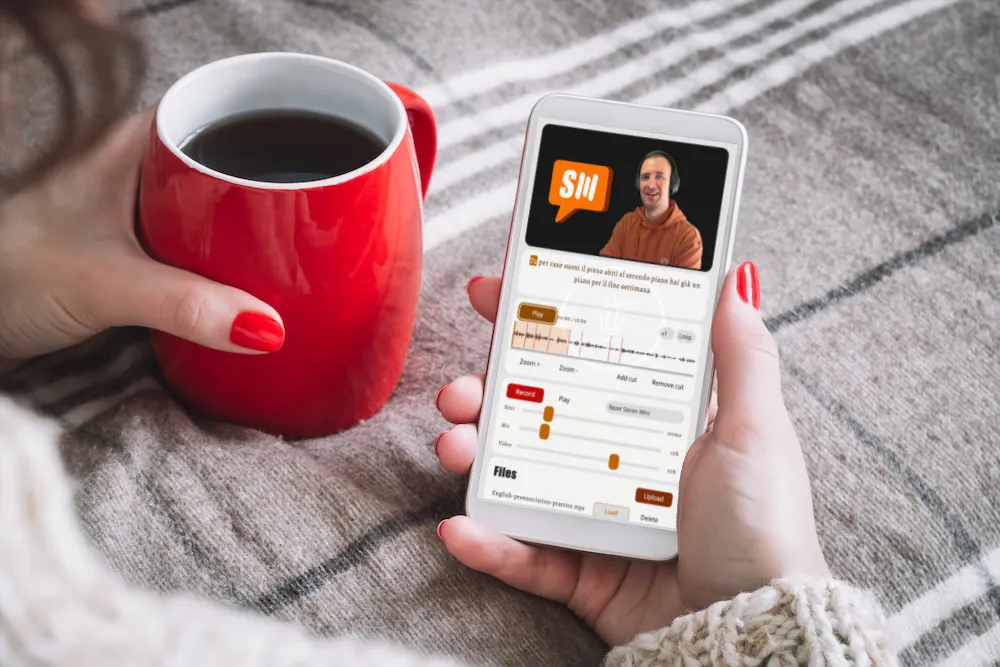
Upload any video. We chunk it into sentences. Slow it down without distortion. Loop the hard parts. Record yourself and compare side by side with the original. No app-switching, no scrubbing, no friction.
If your pronunciation has been stuck for months and nothing seems to shift it, the issue isn’t effort - it’s method. Give ShadowingPRO a try - the free trial doesn’t need a credit card.